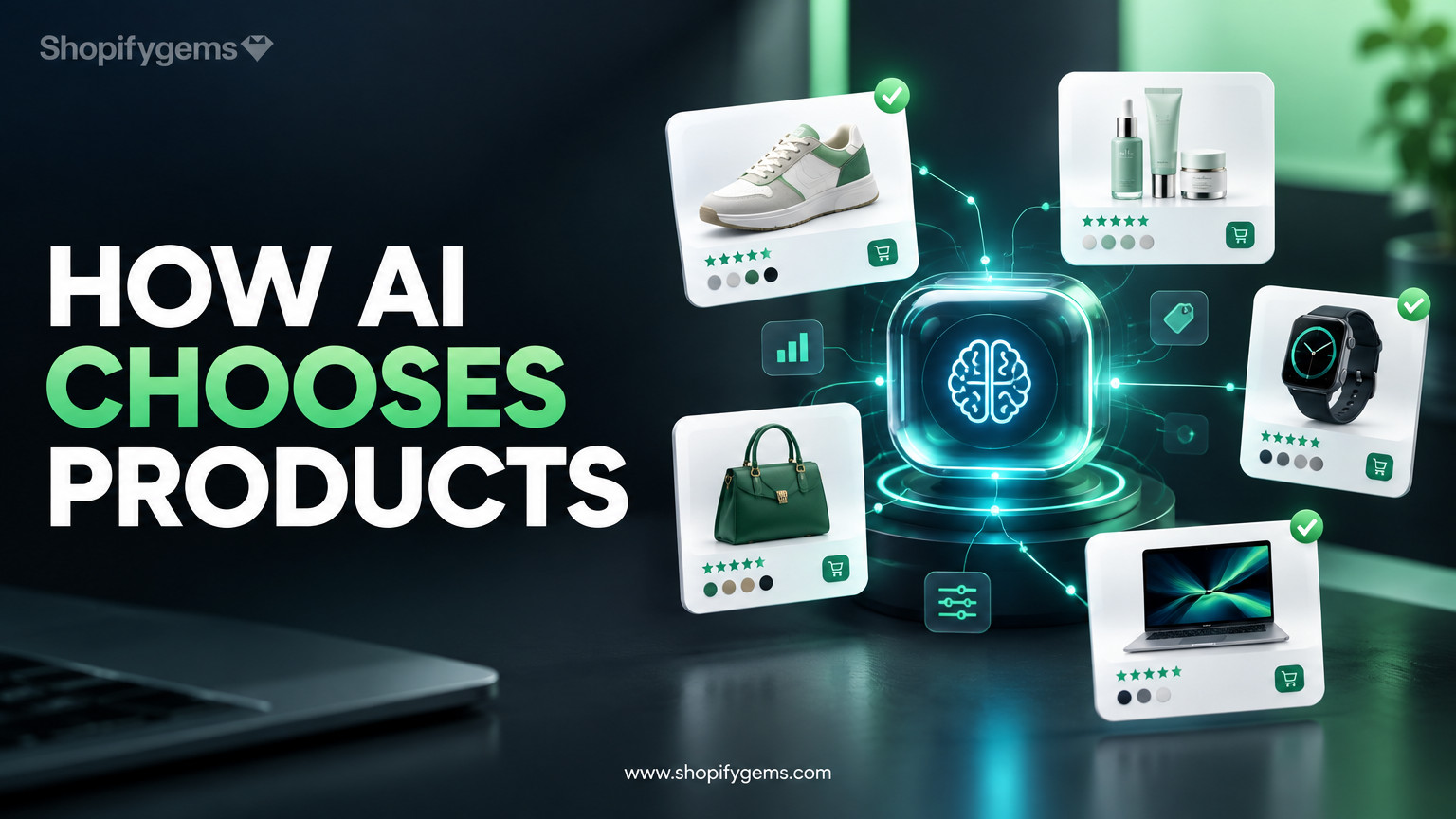
Customers no longer need to know exactly what they want before starting their shopping journey. They can describe a problem, explain their preferences, set a budget, and ask an AI assistant to find suitable products.
Instead of searching for “waterproof hiking shoes”, for example, a customer might ask: “Can you recommend comfortable waterproof hiking shoes for weekend mountain walks under £120?”
An AI shopping assistant can interpret that request, identify relevant product attributes, compare available options, and present a shortlist.
This shift creates a new opportunity for ecommerce businesses. Products need to be discoverable not only through traditional search engines and online marketplaces but also through AI-powered shopping experiences.
Understanding how AI shopping assistants select products is the first step towards improving your store’s visibility in these emerging channels.
Quick Answer: How Do AI Shopping Assistants Choose Products?
AI shopping assistants analyse a combination of information to identify products that match a shopper’s requirements.
Common considerations include:
Search intent: What the customer actually wants to buy.
Product information: Titles, descriptions, specifications, images, and attributes.
Price and availability: Whether the product fits the budget and is currently available.
Reviews and reputation: Customer feedback and other publicly available trust signals.
Relevance: How closely the product matches the customer’s requirements.
Merchant information: Seller identity, product quality, availability, and other shopping considerations.
Personalisation: Preferences, previous interactions, and additional requirements where supported.
There is no single universal ranking formula. Different AI platforms use different data sources, models, policies, and recommendation processes.
For Shopify merchants, the practical priority is to maintain accurate product information, make product attributes easy to understand, and build a trustworthy online presence.
1. Understanding the Customer’s Shopping Intent
The first step is understanding what the shopper is asking for.
Traditional product searches often rely on keywords. A customer might type “leather office bag” and receive a collection of matching product listings.
AI shopping assistants can interpret more detailed, conversational requests.
For example:
“I need a lightweight leather laptop bag for daily commuting. It should fit a 15-inch laptop, have enough space for documents, and cost less than £150.”
The assistant can identify several requirements:
Product type: Laptop bag.
Material: Leather.
Intended use: Daily commuting.
Laptop compatibility: 15 inches.
Additional requirement: Document storage.
Maximum budget: £150.
These requirements help narrow the available product options.
Rather than simply matching the words in the query, the assistant attempts to understand the customer’s underlying needs.
What this means for Shopify merchants
Your product pages should explain what each product is designed for, who it suits, and which problems it solves.
For example, a description such as “Premium leather laptop bag” provides limited information.
A more useful description would explain the material, laptop compatibility, storage capacity, carrying options, and intended use.
The more clearly you communicate these details, the easier it becomes for AI systems to understand product relevance.
2. Product Data Helps AI Understand What You Sell
Product data is one of the most important foundations of AI-powered product discovery.
An AI assistant cannot reliably recommend a product if it cannot understand its specifications, features, price, or availability.
It may gather product information from several sources, including:
Ecommerce product pages.
Structured product data.
Merchant product feeds.
Product catalogues.
Third-party retail platforms.
Publicly available product information.
For Shopify merchants, Shopify Catalog is particularly relevant.
According to Shopify’s documentation, Shopify Catalog provides structured product information that supported AI platforms, shopping sites, and AI agents can use to understand product titles, descriptions, images, pricing, options, and availability.
Eligible products can be included automatically, although inclusion does not guarantee that a product will appear in a particular recommendation.
Which product attributes matter?
| Product attribute | Why it matters |
|---|---|
| Product title | Helps identify the product and its purpose. |
| Description | Explains features, benefits, materials, and use cases. |
| Product category | Provides context about the type of product. |
| Images | Help communicate appearance, design, and product variations. |
| Variants | Identify available sizes, colours, materials, and configurations. |
| Price | Helps determine whether the product meets budget requirements. |
| Availability | Indicates whether the product can currently be purchased. |
| Brand | Identifies the product manufacturer or brand. |
| Identifiers | Help distinguish products and their specific variants. |
Consider a Shopify store selling skincare products.
A product title such as “Daily Moisturiser” tells customers very little.
A detailed product record could explain that it is a fragrance-free facial moisturiser for dry and sensitive skin, available in 50 ml and 100 ml sizes.
This gives AI systems more useful information when matching products with shoppers looking for particular skincare requirements.
3. Relevance Matters More Than Simply Matching Keywords
A product does not become a strong recommendation just because its description contains the same keywords as a customer’s question.
AI assistants need to consider whether the product actually meets the shopper’s requirements.
Imagine someone searching for:
“Running shoes suitable for beginners with wide feet and good cushioning.”
A product page might contain the words “running shoes” several times. However, if the shoes are designed for narrow feet and offer minimal cushioning, they are unlikely to be an appropriate recommendation.
A more suitable product would clearly communicate:
Whether it is suitable for beginner runners.
Whether wide-width options are available.
What type of cushioning it offers.
Its intended running surface.
Relevant sizing information.
This is why detailed and accurate product information matters more than repetitive keyword placement.
Practical recommendation: Review your product descriptions from the customer’s perspective. Ask whether someone unfamiliar with your brand could understand the product’s purpose and determine whether it meets their needs.
4. Price, Availability and Product Variants Influence Recommendations
A product might be an excellent match in terms of features but still be unsuitable because it exceeds the shopper’s budget or is unavailable in the required size.
AI shopping assistants can consider commercial information when comparing products.
For example, a customer asks:
“Find a black office chair with adjustable height, lumbar support, and a budget of £200.”
An assistant may compare several products based on their:
Current selling prices.
Availability.
Adjustable features.
Support options.
Product specifications.
ChatGPT’s published shopping documentation identifies relevance, product metadata, availability, price, and quality among the factors involved in product and merchant selection.
Read: How shopping works in ChatGPT.
Why variant accuracy is important
Variants can create problems when product information is incomplete or incorrectly organised.
Consider a clothing store selling a jacket in five colours and four sizes.
If the product catalogue does not accurately represent these options, an AI shopping assistant may struggle to identify whether the requested size and colour are available.
Shopify merchants should therefore:
Use meaningful variant option names.
Maintain accurate inventory for individual variants.
Keep variant-specific prices correct.
Use appropriate product images.
Ensure product URLs lead to the correct product or selected variant.
Avoid duplicate or confusing product listings.
Shopify also supports product data mapping and variant grouping through Shopify Catalog, which can be useful for stores with complex product structures.
5. Reviews and Brand Reputation Help Establish Trust
Customers rarely evaluate products using specifications alone. They also want reassurance that a product is reliable and worth purchasing.
AI shopping assistants can use publicly available reviews, ratings, and other information to help explain product strengths and weaknesses.
For example, when comparing two coffee machines, an assistant might consider:
Customer feedback about ease of use.
Reported durability.
Cleaning requirements.
Coffee quality.
Common complaints.
Overall value.
Amazon’s Rufus shopping assistant is one example of this approach. Amazon describes Rufus as drawing on its product catalogue, customer reviews, community questions and answers, and information from across the web to support shopping recommendations.
How can Shopify stores strengthen trust?
Start with genuine customer feedback.
Useful actions include:
Collect authentic product reviews after purchases.
Display relevant ratings and customer comments on product pages.
Respond professionally to customer complaints.
Provide clear shipping and return policies.
Maintain consistent brand information across your website and other platforms.
Publish helpful product guides and buying advice.
Avoid generating artificial reviews or publishing unsupported product claims. Trust signals are only useful when they reflect genuine customer experiences.
6. AI Assistants Can Personalise Product Recommendations
Two customers can ask similar questions but receive different recommendations.
Why?
Their preferences and circumstances may differ.
One shopper might prioritise affordability, while another cares more about premium materials. A third may need a product that is compatible with an existing device.
AI assistants can use conversational context and supported personalisation features to refine their suggestions.
For instance:
Customer A: “Recommend a laptop under £800.”
Customer B: “Recommend a laptop under £800 for video editing, with at least 16 GB RAM.”
Although both customers have the same budget, their product requirements are different.
The second request introduces more specific technical requirements, which changes the products that are likely to be relevant.
ChatGPT’s shopping documentation also explains that recommendations can consider the user’s query and context, including available personalisation information.
What merchants should understand: Personalisation is not something a store owner can directly control. However, providing comprehensive product attributes gives AI systems more information to match products with different customer needs.
7. Product Feeds and Structured Data Make Discovery Easier
AI shopping experiences need reliable ways to access product information.
This is where structured product feeds become important.
A product feed organises catalogue information into clearly defined fields that another platform can process.
Instead of trying to interpret an entire webpage, an AI shopping platform can receive specific information about a product, including its title, description, price, image, brand, and stock status.
OpenAI’s Agentic Commerce Protocol (ACP), for example, provides infrastructure for connecting merchant product catalogues with shopping experiences in ChatGPT.
Its product feed documentation outlines the information required to represent products and their purchasable variants.
Useful resources:
The direct product-feed onboarding process is currently limited to approved partners, so merchants should not assume that every store can independently submit a feed.
What should Shopify merchants do?
For most eligible Shopify stores, Shopify Catalog provides an existing route for making product information available to supported AI channels.
Before investing in a separate integration, check whether your products already qualify.
If your store uses custom product data, metafields, metaobjects, or complex variant structures, review how those fields are mapped into Shopify Catalog.
This is particularly important for stores with extensive catalogues or highly configurable products.
8. Technical SEO Still Matters for AI Product Discovery
AI shopping does not make traditional SEO irrelevant.
Product discovery can involve structured catalogues, search indexes, publicly accessible websites, and third-party information. The exact combination depends on the platform.
A technically sound Shopify store helps ensure that product information is accessible, understandable, and consistent.
Here are several areas worth reviewing.
Product page accessibility
Make sure important product information is available in crawlable page content rather than being hidden entirely behind scripts or interactive elements.
Check that:
Product pages return the correct HTTP status codes.
Important product information is accessible to search crawlers.
Canonical URLs are configured correctly.
Product pages are not accidentally blocked from indexing.
Images have descriptive alt text.
Internal links connect related products and collections.
Structured data and schema markup
Structured data provides search engines with additional context about webpage content.
For product pages, relevant Schema.org Product markup can describe information such as:
Product name.
Brand.
Description.
Image.
SKU.
Offers and pricing.
Availability.
Ratings and reviews, where eligible.
Shopify themes and SEO applications may already generate some product structured data. However, implementation varies.
Check your existing markup before adding another schema implementation. Duplicate or conflicting structured data can create unnecessary problems.
You can use Google’s Product structured data documentation to understand the supported properties and requirements.
Consistent information across channels
Your product page, Shopify catalogue, Google Merchant Center data, and other connected channels should communicate consistent information.
For example, if your website lists a product at £79 but another channel still displays £89, customers and AI systems may encounter conflicting information.
Regularly review prices, stock status, product URLs, descriptions, and shipping details.
9. How to Optimise Your Shopify Store for AI Shopping Assistants
Understanding how AI shopping assistants work is useful, but the bigger question is what you can actually do to improve your store’s product visibility.
The following checklist provides a practical starting point.
Shopify AI product discovery checklist
0 of 12 completed
Reset checklist
Step 1: Improve your product titles
Avoid generic titles that do not communicate what the product actually is.
For example:
Weak: Premium Bottle
Better: Insulated Stainless Steel Water Bottle – 750 ml
The improved title communicates the product type, material, and capacity.
Step 2: Write descriptions that answer real questions
Think about the questions customers would ask before purchasing.
For example:
What is the product made from?
What are its dimensions?
Who is it suitable for?
What makes it different?
Is it compatible with other products?
What is included in the package?
Answering these questions naturally makes your product pages more informative.
Step 3: Organise product attributes properly
Use Shopify product categories, types, tags, metafields, and variants appropriately.
For example, a furniture store might use metafields to organise:
Material.
Width.
Height.
Weight capacity.
Assembly requirements.
Room suitability.
This makes product information easier to maintain and reuse across your store and connected channels.
Step 4: Review your Shopify Catalog settings
Check which products are eligible for Shopify Catalog and whether their information is being mapped correctly.
Shopify provides controls for managing product data and access to supported AI channels through its Agentic storefront settings.
Read: Shopify’s guide to optimising products for AI platforms.
Step 5: Build brand authority beyond your product pages
Publish useful buying guides, comparisons, educational articles, and product-related resources.
Maintain consistent brand information and encourage genuine customer feedback.
These activities help establish a broader online presence, although no individual content format or SEO technique guarantees an AI recommendation.
10. Common Mistakes That Can Reduce AI Product Visibility
Even a well-designed Shopify store can struggle with product discovery when its underlying information is incomplete or inconsistent.
Watch out for these common mistakes.
| Common mistake | Why it creates problems | What to do instead |
|---|---|---|
| Generic product titles | Product purpose is unclear. | Use descriptive, specific titles. |
| Thin descriptions | Important attributes are missing. | Explain features, specifications, and use cases. |
| Incorrect inventory | Availability information becomes unreliable. | Keep stock synchronised. |
| Poor variant organisation | AI systems may misunderstand available options. | Use clear variant names and accurate mappings. |
| Duplicate product information | Creates ambiguity across listings. | Maintain consistent product records. |
| Missing policies | Customers and assistants may lack important store information. | Publish clear shipping and return policies. |
| Artificial reviews | Undermines customer trust. | Collect genuine customer feedback. |
| Neglecting technical SEO | Product pages may be difficult to discover or interpret. | Maintain crawlability and valid structured data. |
One important point: AI product recommendations are not entirely controlled by merchants. Even excellent product data cannot guarantee that an assistant will select or rank a particular product.
The objective is to remove avoidable information gaps and make your products easier to understand and evaluate.
11. How to Measure Whether Your Shopify Store Is Appearing in AI Recommendations
AI visibility should be treated as an ongoing measurement exercise rather than a one-time SEO project.
Traditional organic search reports do not necessarily tell the whole story because shoppers can discover products through conversational interfaces and AI-powered shopping channels.
Consider tracking the following:
1. AI-referred website traffic
Review referral sources in Google Analytics 4 and other analytics platforms. Look for identifiable visits originating from AI platforms.
2. Referral-to-purchase conversion
Measure whether visitors arriving through AI experiences browse products, add items to their carts, and complete purchases.
3. Product-level performance
Identify which products attract AI-referred traffic and whether particular categories perform better.
4. Product data accuracy
Periodically compare your Shopify product records with the information displayed in connected shopping experiences.
5. AI shopping visibility tests
Run consistent test prompts across relevant AI assistants.
For example:
Recommend affordable ergonomic office chairs.
Find organic skincare products for sensitive skin.
Compare insulated water bottles under £40.
Record whether your products appear, which attributes are mentioned, and how recommendations change when requirements are refined.
Remember that these tests are directional rather than definitive ranking measurements. AI recommendations can change between queries, users, and sessions.
Shopify’s agentic storefront documentation also explains how AI-channel orders can be attributed in Shopify admin, providing another useful measurement source.
FAQs About AI Shopping Assistants
1. How do AI shopping assistants decide which products to recommend?
They interpret the shopper’s requirements and evaluate relevant product information. Depending on the platform, this can include product descriptions, specifications, price, availability, reviews, merchant information, and personalisation context.
2. Does ChatGPT recommend products based on paid advertising?
ChatGPT’s published shopping documentation states that its product results are independently selected and are not advertisements or influenced by OpenAI partnerships. Sponsored advertising, where displayed, is separate from organic product recommendations.
3. Can Shopify products appear in ChatGPT recommendations?
Yes. Eligible Shopify products can be made available to ChatGPT through Shopify Catalog. Shopify states that eligible products are integrated automatically, without requiring merchants to create a separate product feed. However, this does not guarantee that a product will appear in a particular recommendation.
4. Do I need a separate AI SEO application for my Shopify store?
Not necessarily. Start by improving your existing product information, technical SEO, structured data, and Shopify Catalog setup. Additional applications or custom integrations may be useful if your store has specific data management or integration requirements.
5. What is Generative Engine Optimisation (GEO)?
Generative Engine Optimisation (GEO) refers to practices designed to improve how a brand, website, or product is understood and represented in AI-generated answers and recommendations.
It complements traditional SEO rather than replacing it.
6. How long does it take for AI assistants to recognise product updates?
There is no universal timeframe. It depends on how the AI platform receives and refreshes product information, whether through catalogue integrations, feeds, or website crawling. Shopify Catalog provides ongoing product data updates to connected AI channels, but the timing of individual updates and recommendation changes can vary.
Conclusion: Prepare Your Shopify Store for AI-Powered Product Discovery
AI shopping assistants are changing how customers research and compare products. Instead of relying exclusively on traditional search results, shoppers can now describe their requirements and receive curated recommendations through conversational experiences.
For Shopify merchants, this creates an additional product discovery opportunity.
The most useful starting point is not chasing a secret AI ranking formula. It is building a store with accurate product information, detailed descriptions, well-organised variants, reliable inventory, genuine customer reviews, and accessible technical foundations.
Shopify Catalog and emerging agentic commerce integrations also make it increasingly important to think about how product information is shared beyond your storefront.
At ShopifyGems, we help businesses build, customise, and optimise Shopify stores with a focus on performance, usability, and scalable ecommerce experiences.
If you want to prepare your Shopify store for evolving AI-powered shopping experiences, get in touch with ShopifyGems to discuss your store’s technical and product discovery requirements.