Shopify continues to expand beyond traditional ecommerce, and its Fall 2026 edition makes that direction particularly clear. With artificial intelligence, agentic commerce, smarter store management, and more connected shopping experiences taking centre stage, the latest updates could influence how merchants attract customers, manage operations, and grow their businesses.
Titled Exponential, Shopify Editions Fall 2026 introduces improvements across 11 areas, including AI-powered shopping, Sidekick, online stores, merchandising, retail, payments, operations, marketing, fulfilment, and developer tools.
But what do these announcements actually mean for your business?
For Shopify merchants, the important question isn’t simply which features are new. It’s which updates can improve product discovery, reduce manual work, increase customer confidence, and create a better buying experience.
Let’s explore the most important developments and what merchants should consider doing next.
Quick Answer: What’s New in Shopify Editions Fall 2026?
Shopify Editions Fall 2026 focuses on making ecommerce more intelligent, connected, and automated.
Some of the most notable developments include:
- AI-powered product discovery through agentic shopping experiences.
- Expanded Sidekick capabilities for store management and editing.
- Canvas for managing and designing an entire online store.
- Improved product merchandising and catalogue management.
- Better retail experiences through Shopify POS.
- Enhanced fraud prevention and payment management.
- More powerful Shopify Flow automation.
- Improved marketing reporting and campaign automation.
- Expanded developer tools for building AI-ready commerce experiences.
The overall direction is clear: Shopify wants merchants to spend less time managing disconnected processes and more time improving their businesses.
1. Agentic Commerce Is Becoming a Bigger Part of Shopify
THE BIGGEST STRATEGIC DEVELOPMENT

One of the biggest themes in Shopify Editions Fall 2026 is agentic commerce.
Traditional online shopping usually follows a familiar journey. A customer visits a store, searches for a product, compares options, adds something to their cart, and completes checkout.
Agentic commerce introduces another possibility: AI agents can help shoppers discover products, compare options, create carts, and move towards purchasing through conversational experiences.
Shopify is expanding its infrastructure to support these experiences.
The Fall 2026 announcements include:
- Shop skills for AI agents.
- Google AI Mode and Gemini integrations.
- Shop Pay working as a wallet in agentic experiences.
- Shopify Catalog product discovery.
- Store previews within agents.
- Digital products becoming available through agentic channels.
- New connectors for AI platforms.
Shopify also reports that more than one billion products in its catalogue can be discovered across AI channels.
What does this mean for merchants?
Product discovery may increasingly happen outside traditional search engines and online storefronts.
A customer could ask an AI assistant to recommend a particular product based on their budget, preferences, or requirements. Instead of browsing multiple websites manually, they could discover suitable products through an AI-powered experience.
For merchants, this makes product data quality increasingly important.
Consider reviewing:
- Product titles and descriptions.
- Product images and variant information.
- Pricing and availability.
- Product categories and attributes.
- Shipping and market information.
Well-organised product information gives shopping systems more useful information to work with.
Merchants should also pay attention to their product catalogue eligibility and the channels through which their products can be discovered.
2. Shopify Sidekick Is Becoming a More Capable Store Assistant
Image Credit – Shopify
Shopify Sidekick is becoming more than a tool for answering basic questions about your store.
Fall 2026 introduces several improvements designed to help merchants manage everyday ecommerce activities using AI.
Notable updates include:
- Bulk editing with Sidekick.
- Store improvements suggested by Sidekick.
- Research across apps and the web through Sidekick Pulse.
- Draft order creation and editing.
- Print-on-demand product assistance.
- Pricing recommendations.
- Payments and fraud guidance.
- Sidekick assistance within the checkout editor and Checkout Blocks app.
These capabilities could make routine store management considerably more efficient.
For example, imagine a merchant preparing a seasonal product launch. Instead of manually reviewing every product, they could use Sidekick to help identify relevant changes, organise product information, and prepare draft updates.
However, AI-generated recommendations should still be reviewed before being published.
What merchants should do
Start by identifying repetitive tasks that consume time. Product editing, pricing reviews, order preparation, and routine store improvements are useful areas to evaluate.
Sidekick should support decision-making rather than replace business judgement.
3. Canvas Makes Online Store Design More Connected
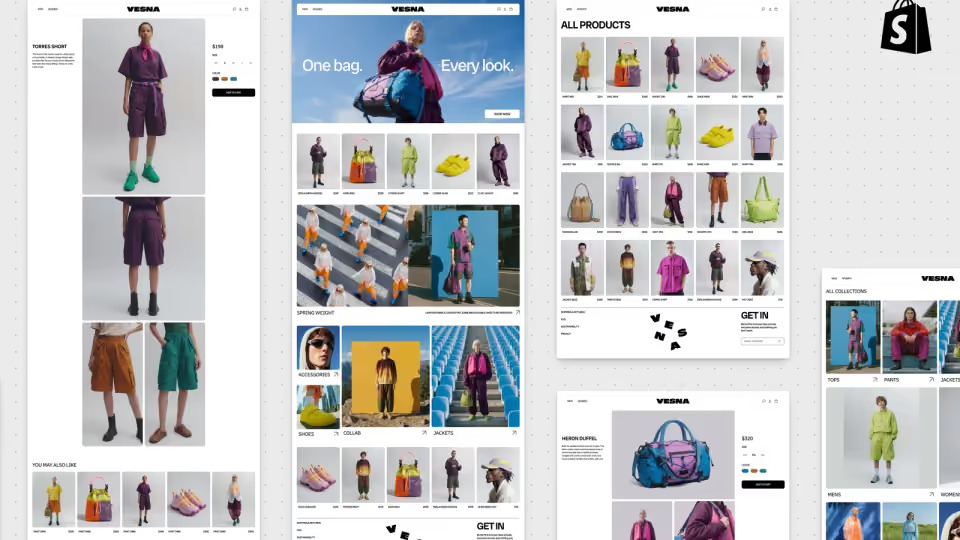
Shopify is also improving how merchants approach storefront design.
The new Canvas experience provides a way to view and edit an entire online store in one workspace.
Merchants can explore different templates, make design changes, and work with Sidekick to turn ideas into storefront improvements.
This is particularly interesting for businesses that regularly update their websites for product launches, promotional campaigns, or seasonal events.
Other online store improvements include:
- A redesigned online store management page.
- A smarter Shopify Inbox shopping assistant.
- Improved predictive search and product suggestions.
- Support for right-to-left languages such as Arabic, Hebrew, and Urdu.
- Better translation synchronisation.
- More flexible store rollouts across channels.
Shopify reports that add-to-cart activity from storefront search has improved by 8% with its stronger predictive search and suggestions.
That matters because customers who can find relevant products more easily may be more likely to continue shopping.
Why this matters for your business
Your storefront is not simply a digital catalogue. It influences how customers discover products, understand your brand, and decide whether to purchase.
Consider reviewing your navigation, search experience, product pages, mobile layouts, and promotional sections.
A visually attractive website is useful, but it also needs to make shopping straightforward.
4. Product Merchandising Gets More Flexible

Product merchandising has a direct influence on how customers interact with an online store.
Shopify’s Fall 2026 updates introduce several improvements that give merchants more control over product information and catalogue organisation.
Some notable additions include:
Product data mapping by channel
Merchants can customise product information for different sales channels while keeping their catalogue updated.
This is useful when different platforms require different product descriptions, attributes, or presentation formats.
Multi-source product collections
Merchants can combine products, apps, and variants into collections, making catalogue organisation more flexible.
Improved variant management
Product and variant details can be managed together through a clearer product page layout and bulk editing controls.
Multiple barcodes
Shopify now supports up to 20 barcodes for each product variant, with built-in format validation.
Digital products
Merchants can add a URL to a product, assign a price, and sell access to digital resources such as templates and bookings.
These improvements could be particularly valuable for stores with large catalogues, multiple product variations, or different sales channels.
For growing businesses, organised product data also supports better inventory management and more consistent customer experiences.
5. Shopify POS Strengthens Online and Offline Retail

Shopify continues to bring online and physical retail operations closer together.
Fall 2026 introduces several Shopify POS improvements designed to simplify in-store shopping and make retail management more efficient.
Important developments include:
- Improved customer recognition at physical stores.
- Faster POS checkout processes.
- Better product, order, and customer search.
- Local delivery options at checkout.
- Access to abandoned online carts through POS.
- Improved stock counting.
- Saved carts across POS devices.
- Better staff activity tracking.
- Centralised staff management.
One particularly interesting development is expanded customer recognition.
Shopify states that a known in-store customer has more than 60% higher lifetime value than an unknown customer.
This reinforces the importance of connecting customer information across different shopping channels.
For example, a customer might browse products online, visit a physical store to see them in person, and complete the purchase with assistance from a sales associate.
A connected retail system makes that journey easier to manage.
Merchant takeaway: If your business operates both online and offline, review how your customer data, inventory, orders, and staff workflows are connected.
6. Payments and Fraud Prevention Receive Important Improvements
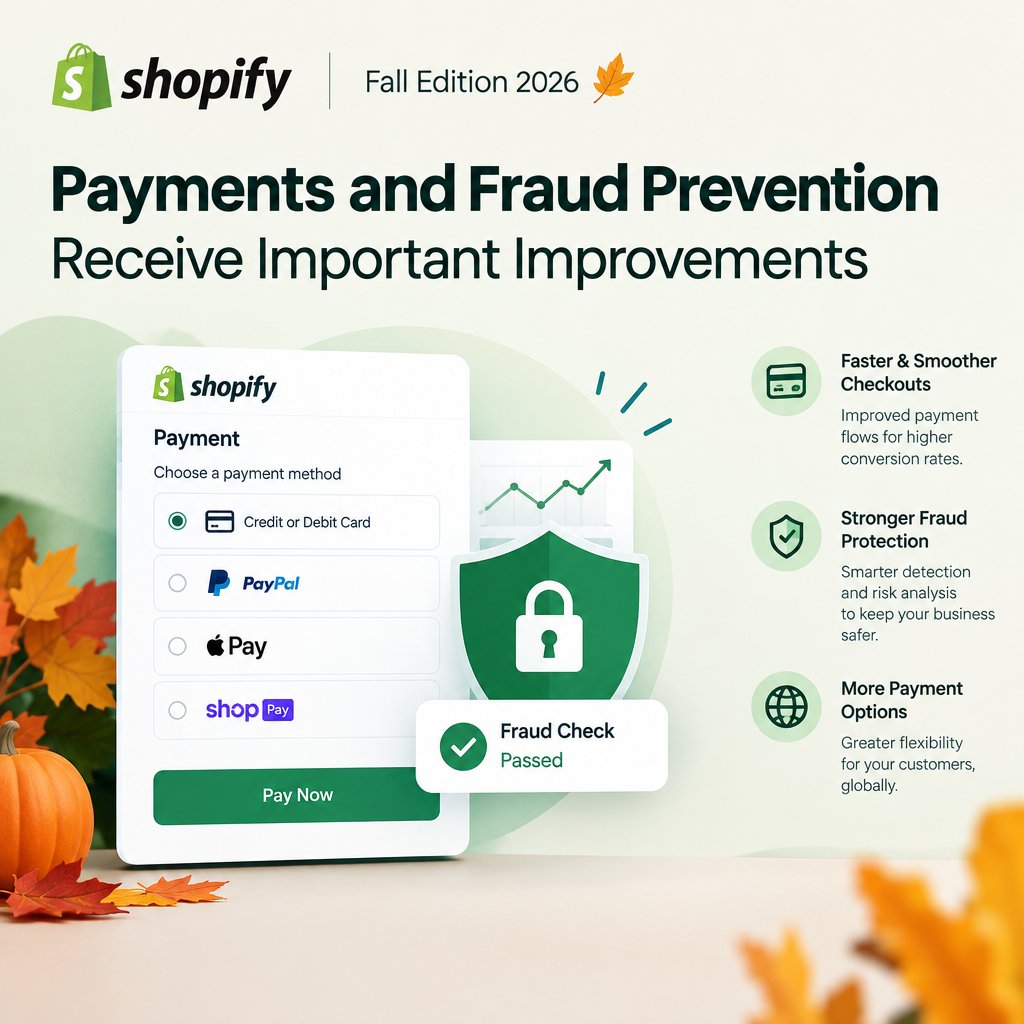
Payment reliability and fraud prevention directly affect ecommerce profitability.
Shopify’s Fall 2026 edition introduces improvements that help merchants understand payment risks, manage disputes, and provide more flexible checkout experiences.
Key developments include:
- Stronger fraud prevention through Shopify Protect.
- Blocking certain high-risk payments before payment authorisation.
- Improved risk information on orders.
- Custom fraud rules.
- AI-generated chargeback responses.
- Automatic proof-of-delivery information for disputes.
- Expanded local payment methods.
- Improved payout reporting.
- More flexible checkout customisation.
Shopify also highlights improvements to international payments through Shopify Payments and Managed Markets.
For international merchants, local payment preferences and clearer pricing can make a meaningful difference to the shopping experience.
The edition also introduces checkout improvements such as:
- Custom checkout fields.
- A redesigned payment method layout.
- Additional fee configuration.
- Improved form layouts.
- Apple Pay support in more browsers, with rollout dependent on availability.
What should merchants consider?
Review your checkout experience from a customer’s perspective.
Are payment methods relevant to your target markets? Are delivery instructions easy to provide? Are there unnecessary checkout steps?
Also review your fraud prevention settings and dispute-handling processes.
A secure checkout should protect the business without creating unnecessary friction for legitimate customers.
7. Shopify Flow and Store Operations Become More Intelligent

Running a Shopify store involves more than selling products.
Merchants also manage inventory, suppliers, customer communications, fulfilment, staff access, and reporting.
Shopify’s Fall 2026 updates introduce improvements designed to make these activities easier to manage.
One important development is the expansion of Shopify Flow.
New capabilities include:
- More workflow update triggers.
- Granular permissions for automation management.
- AI Toolkit support for creating and managing workflows.
- Workflow versioning.
- Better review and restoration of previous workflow versions.
These features can help merchants build more reliable automated processes.
For example, a business could use automation to respond to product changes, update internal processes, or trigger specific actions when selected product information changes.
Other operational improvements include:
- A redesigned Shopify admin.
- Stronger admin search.
- Store audit logs.
- Improved file organisation.
- Quick metafield editing.
- More detailed analytics.
- Better purchase order reporting.
- Improved store health monitoring.
The practical benefit is better visibility and less repetitive administration.
For businesses with growing teams, stronger permissions and workflow management also make it easier to maintain consistent processes.
8. Marketing Automation Expands Across More Channels

Marketing is another major focus of Shopify Editions Fall 2026.
Shopify is expanding its campaign automation capabilities to help merchants manage advertising, reporting, and customer communication across more channels.
Some of the important announcements include:
Campaign Autopilot
Shopify is expanding AI-powered campaign management across additional advertising channels, including Microsoft Advertising and Snapchat, with X Ads also announced as an upcoming channel.
Unified marketing reports
Merchants can get a clearer view of how different marketing channels contribute to sales.
This is important because understanding which channels generate revenue helps businesses make better decisions about advertising budgets.
WhatsApp marketing
Shopify is introducing WhatsApp marketing consent collection at checkout and automated marketing messages through Shopify Messaging.
Shop Campaigns
Shop Campaigns is expanding into more markets, giving eligible merchants additional opportunities to acquire customers.
TikTok and ChatGPT advertising
The edition also introduces additional advertising opportunities through TikTok and ChatGPT Ads.
These developments show how ecommerce marketing is becoming more integrated with the Shopify platform.
However, merchants should not assume that adding more channels automatically improves performance.
The priority should remain understanding customer behaviour, measuring campaign profitability, and selecting channels that suit the business.
9. Fulfillment and Returns Receive Practical Improvements

Fulfillment is often one of the most overlooked parts of ecommerce growth.
A customer might have a great experience browsing and purchasing a product, but delayed delivery or a complicated return process can damage their overall perception of a brand.
Shopify’s Fall 2026 edition includes several improvements to fulfillment and inventory management.
These include:
- Expanded shipping support in selected markets.
- Default packaging by product variant.
- Better cross-border shipping label management.
- More flexible self-service returns.
- Return rules by market.
- Native stock counting improvements.
- Better barcode scanning.
- Improved inventory transfer information.
- Additional order editing capabilities.
These changes are particularly relevant to businesses selling across multiple regions.
For example, a merchant serving different international markets may need different return rules, shipping arrangements, and operational processes.
Better native tools can reduce the need to manage these activities through disconnected systems.
Merchants should review their shipping settings, return policies, packaging rules, and inventory processes to identify opportunities for improvement.
10. Shopify Developers Get New Tools for Building Commerce Experiences

Shopify’s developer updates are particularly important for agencies, app developers, and businesses using custom storefront functionality.
Fall 2026 introduces improvements across APIs, app development, theme architecture, and AI integrations.
Some notable developments include:
- Universal Commerce Protocol support.
- Expanded Shopify Catalog API capabilities.
- WebMCP tools for the customer shopping journey.
- New Polaris component APIs.
- Improved developer dashboard.
- More detailed app event analytics.
- Improved Shopify CLI support for AI-assisted development.
- Python and PHP app packages.
- Updated theme architecture.
- Additional Hydrogen development capabilities.
One of the most interesting areas is the Universal Commerce Protocol (UCP).
UCP provides a structured way for commerce systems and AI agents to interact with product discovery, carts, checkout, and order information.
Shopify’s developer documentation explains how its catalogue interfaces support product discovery across Shopify merchants and individual storefronts.
For developers, this creates opportunities to build new shopping experiences beyond traditional storefront browsing.
The updated theme architecture is also worth watching.
Shopify is introducing more flexible theme-building capabilities, including reusable blocks and improved support for AI-assisted development.
Why this matters to merchants
Custom development is not becoming less important. Its role is evolving.
Businesses may need developers to integrate new technologies, improve storefront functionality, optimise performance, and connect their stores to emerging shopping channels.
The right technical implementation will help merchants take advantage of new capabilities without compromising their existing store experience.
11. What Shopify Merchants Should Prioritise After These Updates
With so many announcements, it can be tempting to explore every new feature immediately.
A better approach is to prioritise updates according to your business requirements.
Here is a practical way to approach Shopify Editions Fall 2026.
Business priority Updates worth exploring Potential benefit Customer acquisition Agentic commerce and marketing automation More product discovery opportunities Conversion optimisation Predictive search and checkout improvements Easier shopping journeys Store management Sidekick and Canvas More efficient store updates Product management Merchandising and catalogue tools Better product organisation Retail operations Shopify POS improvements Connected online and offline selling Risk management Shopify Protect and payment updates Better fraud and dispute management Automation Shopify Flow improvements Less repetitive manual work International expansion Payments, shipping and translations Better regional shopping experiences Custom development UCP, APIs and theme architecture More flexible commerce experiences Before implementing anything, consider these steps:
Step 1: Review your current store performance.
Identify where customers experience friction. Look at search activity, product-page engagement, checkout abandonment, and customer support requests.
Step 2: Identify repetitive tasks.
Find administrative processes that could benefit from Sidekick or Shopify Flow.
Step 3: Review your product information.
Make sure product descriptions, images, variants, prices, and inventory details are accurate and consistent.
Step 4: Evaluate your customer journey.
Check how customers discover products, navigate your store, select payment methods, and complete purchases.
Step 5: Check feature availability.
Some announcements are still in early access or rolling out. Confirm eligibility and availability before committing development resources.
Step 6: Plan custom improvements.
If your business relies on complex integrations, custom themes, or advanced functionality, consider whether professional Shopify development support would make implementation easier.
What Does Shopify Editions Fall 2026 Mean for the Future of Ecommerce?
The biggest takeaway from Shopify Editions Fall 2026 is that ecommerce is moving towards more connected and intelligent experiences.
AI is becoming part of product discovery and store management. Shopping is expanding beyond traditional storefronts. Payment and fulfilment systems are becoming more flexible, while developers are gaining additional tools to build commerce experiences across different platforms.
For merchants, these developments create opportunities, but they also introduce new considerations.
Businesses will need to maintain accurate product information, deliver consistent customer experiences, manage data responsibly, and ensure their storefronts are technically prepared for changing shopping behaviours.
Not every new feature will be relevant to every business. The most successful approach is to understand what your customers need and adopt the updates that support those goals.
How ShopifyGems Can Help Your Business Make the Most of Shopify’s New Features
Keeping up with Shopify updates is one thing. Implementing them effectively is another.
Whether you’re planning a new Shopify store, improving an existing storefront, integrating third-party applications, or building custom functionality, the right technical approach can make a significant difference.
At ShopifyGems, we help ecommerce businesses build, customise, and optimise Shopify stores with a focus on usability, performance, and business requirements.
From custom Shopify development and theme improvements to app integrations and performance optimisation, our goal is to help businesses create better ecommerce experiences.
Exploring Shopify’s latest capabilities and wondering how they could benefit your store?
Get in touch with ShopifyGems to discuss your Shopify development requirements.
Frequently Asked Questions
1. What is Shopify Editions Fall 2026?
Shopify Editions Fall 2026 is Shopify’s collection of product updates and announcements under the theme Exponential. It covers 11 areas, including AI commerce, Sidekick, online stores, merchandising, retail, payments, operations, marketing, fulfilment, and developer tools.
2. What is the biggest update in Shopify Fall 2026?
Agentic commerce is one of the most significant developments. Shopify is expanding product discovery and purchasing capabilities across AI-powered shopping experiences, supported by its catalogue infrastructure and Shop Pay.
3. What is new in Shopify Sidekick?
Sidekick receives improvements for bulk editing, draft order management, pricing guidance, print-on-demand assistance, store improvements, research, and checkout customisation.
4. Does Shopify Fall 2026 introduce new AI features?
Yes. The edition includes expanded Sidekick functionality, AI-powered campaign management, agentic shopping integrations, AI-assisted workflow development, and new tools for developers building commerce experiences.
5. Will Shopify Fall 2026 updates be available to every merchant?
Not necessarily. Some features are available, while others are in early access, rolling out gradually, or marked as coming soon. Availability can depend on the feature, merchant eligibility, subscription plan, market, and rollout schedule.
6. How can merchants prepare for agentic commerce?
Merchants should maintain accurate product information, structured product attributes, current pricing, availability, and clear shipping information. They should also monitor Shopify’s supported AI shopping channels and catalogue eligibility.
7. Do merchants need a Shopify developer to implement the new features?
Not for every update. Many built-in features can be managed through Shopify’s admin. However, custom integrations, advanced theme modifications, API development, and complex storefront improvements may require experienced Shopify developers.
8. Where can I find the complete Shopify Editions Fall 2026 announcement?
You can explore the complete official announcement on Shopify Editions Fall 2026.
Approximate article body word count: 2,150 words, excluding metadata, link notes, and image prompts.